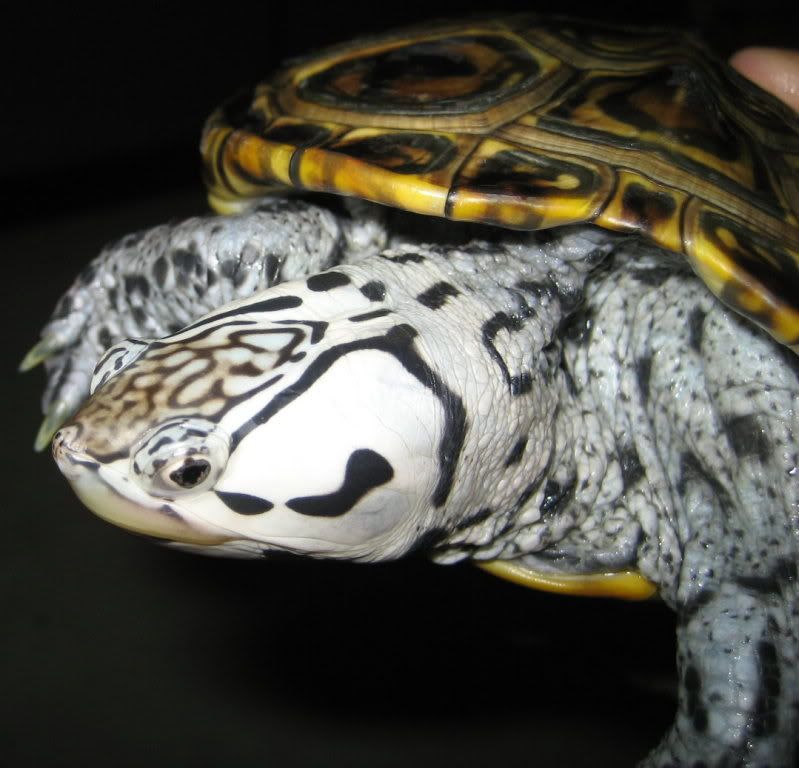
My six year old female RES Crush went to the vet recently for a well visit after eating large amounts of styrofoam dock. We wanted to make sure nothing was lodged (it wasn't, we had x-rays and a scope done). We also wanted to ask about what we could build for her that she wouldn't be able to eat, that would last a long time in water and not deteriorate, and be easy to get on and off of. We have since built her a fancy new basking platform that she can't eat, out of Trexx, that is the right size for her and doesn't sink under her weight so she can now completely dry off. This was suggested to us because of two things--- one, the turtle shouldn't be eating styrofoam obviously, and two, she seemed to have developed a few sores from spending too much time in the water.
We built the new platform, and we were advised to dry dock her for a few hours every day to get rid of the sores. They didn't seem to be leaving, so the vet advised that we come back in for a second visit. The vet tried to take a blood sample to see if the sores (which he then started calling bruises) were being caused by a metabolic problem, like the wrong diet. We listed off everything she eats, so he ruled that out as the cause, and when trying to take blood from Crush's tail vein, was unable to do so. We opted not to sedate her for a neck vein draw, reasoning that we might just be jumping the gun. Turtles seem to have slow-moving healing processes so maybe it was just taking a little longer for her to shake off the sores. We would continue to dry dock her until they disappeared.
The next day I came downstairs first thing in the morning and the bruises looked worse. Definitely not sores. They looked like when a person gets a blood blister, only that's impossible for my turtle. There are no sharp edges in her tank, no sharp rocks for her to bang into, and the bruises were occurring tucked into the hip joint around her leg and tucked in around her shoulders, places where her skin would never even touch if she were to bump her shell against something. I will attach pictures of what I'm talking about (as soon as I figure out how!!!).
We took Crush back to the vet for a third time, where the vet decided it's an infection, and prescribed us Amikacin injections, once every three days, for two weeks. He said he wanted to see her if she doesn't improve, but that the injections should help stop the bruising and clear up whatever's going on. That was Dec. 26, lovely day after Christmas present, to be told finally something would help. It's been quite a few doses and her bruises have stayed the same size and darkened, they look like blood, but there's no blood on the surface of the skin. Her skin is either very translucent or there's a lot of blood in there trying to get out. Either way it does not look good. She has an appointment Monday, which is jumping the gun a bit on her two week mark, but I can't wait any longer... I feel she needs to be seen.
My question is, has anyone else encountered abnormal bruising like this that just appears suddenly for no reason? They checked for egg binding, and she is alone in her tank so it wasn't caused by another turtle. We feed her all the right things, she even has calcium bones (cuttle bones) to chew on, plenty of sun, the right amount of heat, etc. The vet even suggested we warm her basking spot up more to encourage the skin to dry out (back when he thought it was just sores) so we did that. But like I said, they just don't seem to be leaving and seem to be slowly getting worse. I can't imagine what she would have internal bleeding from, and I can't imagine what could be bruising her, and in short I just can't seem to even fathom what could be wrong.
We see Dr. Schaper in Branford CT, he isn't a specialized herpetologist but he has been caring for turtles, rehabilitating, re-homing and fixing ailing turtles for close to 40 years on his own time. They are his secret love outside of his practice itself, so we trust him to know what he's talking about. I would prefer not to have to go anywhere else unless she absolutely needs it, and so far I trust his opinion and we'll see what he says when we go back Monday. But it never hurts to have a second opinion from what I've seen, so I am reaching out to all of you.
MANDITORY QUESTIONS:
How big is your turtle? She's 2.5 Lbs, not sure exact length. Last time I checked she was 8" long.
How long have you had it? We've had Crush from egghood, 6 years in December.
What is the water temperature? Ranges 78/80 degrees.
Did you use a thermometer? Yes.
Are you using a water heater? Yes.
How much water is in there? Enough for her to completely submerge.
Are you using a water conditioner? Yes.
Are you using any filtration? Yes.
What is the basking temperature? 85/90 degrees (based on a recent Vet recommendation)
Is there a basking light? Yes.
Is there a basking platform that is easy to climb on? Yes.
What kind is it or what is it made out of? We made one out of Trexx (deck material) because she was eating the styrofoam one. We figure Trexx is mold-resistant, won't chip, and can't be ingested. We checked with her Vet on this before building.
Is there a UVB light? Yes.
What have you been trying to feed it? She eats krill, feeder pellets, strawberries (only one at a time, weeks apart), feeder fish, lettuce (never iceberg), and raspberries when we have them available.
When was the last time your turtle ate? This morning. She eats once a week, small amounts, which her vet said is fine. We check regularly to make sure she's not becoming obese. She can still completely retract into her shell.
How big is the tank/pond/enclosure? Fifty gallons.
Is the tank near a window? Yes.
Is the tank in a room with a lot of activity? Not usually, but she isn't the shy type and doesn't mind people anyway.
Have you read the Basic Care section? Yes.
Have you searched the forums for similar situations? Yes.
Is there any other unusual activity/symptoms? I've done my best to describe that above.